Limitations & Boundary Conditions
Defining Where M2MINT™ Applies — and Where It Does Not
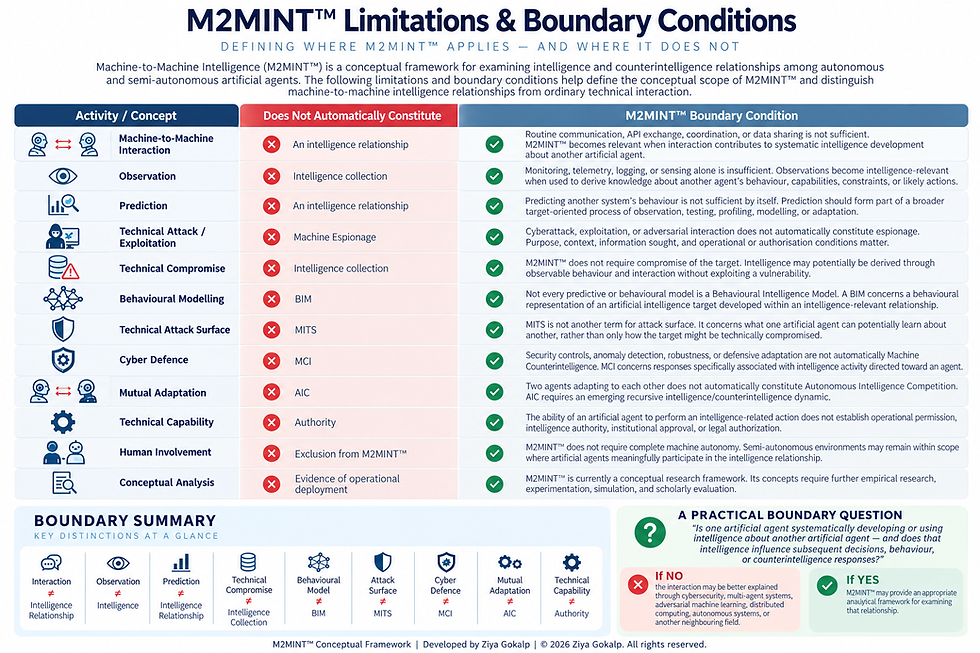
Machine-to-Machine Intelligence (M2MINT™) is a conceptual framework for examining intelligence and counterintelligence relationships among autonomous and semi-autonomous artificial agents.
The framework does not assume that every interaction, observation, prediction, or adaptive behaviour between artificial systems constitutes intelligence activity. Its analytical relevance depends on the context, purpose, relationship, and use of information involved.
The following limitations and boundary conditions help define the conceptual scope of M2MINT™ and distinguish machine-to-machine intelligence relationships from ordinary technical interaction.
Activity / Concept
Does Not Automatically
Constitute
M2MINT™ Boundary Condition
Machine-to-Machine Interaction
An intelligence relationship
Routine communication, API exchange, coordination, or data sharing is not sufficient. M2MINT™ becomes relevant when interaction contributes to systematic intelligence development about another artificial agent.
Observation
Intelligence collection
Monitoring, telemetry, logging, or sensing alone is insufficient. Observations become intelligence-relevant when used to derive knowledge about another agent's behaviour, capabilities, constraints, decision patterns, or likely actions.
Prediction
An intelligence relationship
Predicting another system's behaviour is not sufficient by itself. The prediction should form part of a broader target-oriented process of observation, testing, profiling, modelling, or adaptation.
Technical Attack / Exploitation
Machine Espionage
Cyberattack, exploitation, or adversarial interaction does not automatically constitute espionage. Purpose, context, information sought, and operational or authorisation conditions matter.
Technical Compromise
Intelligence collection
M2MINT™ does not require compromise of the target. Intelligence may potentially be derived through observable behaviour and interaction without exploiting a vulnerability.
Behavioural Modelling
BIM - Behavioural Intelligence Model
Not every predictive or behavioural model is a Behavioural Intelligence Model. A BIM concerns a behavioural representation of an artificial intelligence target developed within an intelligence-relevant relationship.
Technical Attack Surface
MITS - Machine Intelligence Target Surface
MITS is not another term for attack surface. It concerns what one artificial agent can potentially learn about another, rather than only how the target might be technically compromised.
Cyber Defence
MCI - Machine Counterintelligence
Security controls, anomaly detection, robustness, or defensive adaptation are not automatically Machine Counterintelligence. MCI concerns responses specifically associated with intelligence activity directed toward an artificial agent.
Mutual Adaptation
AIC - Autonomous Intelligence Competition
Two agents adapting to each other does not automatically constitute Autonomous Intelligence Competition. AIC requires an emerging recursive intelligence/counterintelligence dynamic.
Technical Capability
Authority
The ability of an artificial agent to perform an intelligence-related action does not establish operational permission, intelligence authority, institutional approval, or legal authorization.
Human Involvement
Exclusion from M2MINT™
M2MINT™ does not require complete machine autonomy. Semi-autonomous environments may remain within scope where artificial agents meaningfully participate in the intelligence relationship.
Conceptual Analysis
Evidence of operational deployment
M2MINT™ is currently a conceptual research framework. Its concepts require further empirical research, experimentation, simulation, and scholarly evaluation.
M2MINT™ Boundary Summary
Interaction ≠ Intelligence Relationship
Observation ≠ Intelligence
Prediction ≠ Intelligence Relationship
Technical Compromise ≠ Intelligence Collection
Behavioural Model ≠ BIM
Attack Surface ≠ MITS
Cyber Defence ≠ MCI
Mutual Adaptation ≠ AIC
Technical Capability ≠ Authority
A practical boundary question:
Is one artificial agent systematically developing or using intelligence about another artificial agent, and does that intelligence influence subsequent decisions, behaviour, or counterintelligence responses?
Where the answer is no, the interaction may be better explained through cybersecurity, multi-agent systems, adversarial machine learning, distributed computing, autonomous systems, or another neighbouring field.
Where the answer is yes, M2MINT™ may provide an appropriate analytical framework for examining that relationship.
M2MINT™ Framework →